
I wanted a TV for the basement. Big, 55 inches or more, and cheap, because it will be on maybe twice a month. My budget was 150 euros, which in a shop buys you nothing of that size and on Wallapop buys you a research project.
You know the project. You type “tv 55”, you get four hundred results, and half of them are wall mounts. The good ones have three blurry photos and a description that says “works perfectly”. Is a 2014 flagship better than a 2021 budget model? What did it cost new? Is “LG 55 4K” at 100 euros a bargain or a warning? By the time you’ve looked up the fifth model number, the first one has been sold to somebody faster.
So this time I didn’t do it. I told Claude Code to open a browser on Wallapop’s public listings, no account and no login, with one instruction: find me a good used TV within 50 km, 55 inches or more, ideally 150 euros or less. Give me a shortlist of ten, and for each one tell me the model year, what it cost new and whether it’s any good.
2,901 listings, read so I didn’t have to
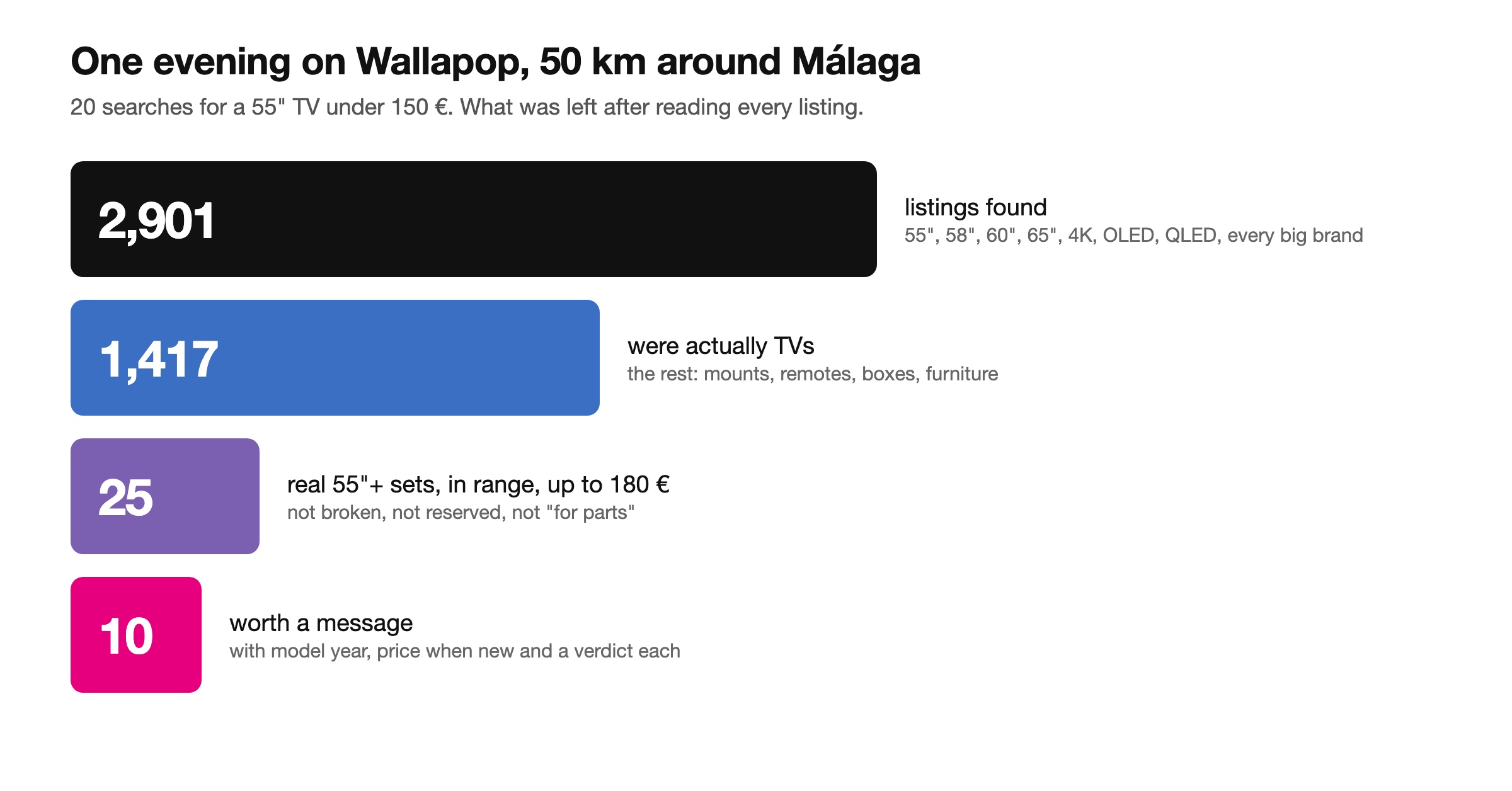
It ran 20 searches: every size from 55 to 75 inches, 4K, OLED, QLED, the main brands. That gave 2,901 listings. 1,417 of them were actually TVs. After keeping only 55 inches and up, within 50 km, up to about 180 euros, and throwing out everything broken, reserved or “for parts”, there were about 25 left.
Twenty-five. That number alone was worth the exercise. Under 150 euros, nearly every big TV has a catch, and now I knew the whole market fitted on one screen.
The shortlist came back as a table, and it read like advice from a friend who knows TVs:
- A 2021 Samsung 55″ 4K at 140 €, 1 km away. Cost 450 to 600 € new. “Best pick: newest Samsung here, current apps, posted two days ago.”
- A 2014 curved LG flagship at 150 €. Around 2,000 € when new. Premium panel, but no HDR and dated apps: “plan on a 30 € streaming stick.”
- A 2012 Panasonic plasma at 110 €. A 2,500 € TV in its day. “Best picture for films, at the cheapest price. The catches: heavy, power-hungry, possible burn-in.”
- A budget-brand 55″ at 130 €: “I couldn’t confirm whether it’s 4K. Ask for the model label.”
Notice the last one. It didn’t pretend to know. Where it estimated a price, it said “my estimate”. That’s the difference between a shortlist you can act on and one you have to re-check.
I messaged the Samsung seller within minutes. She had already promised it to someone for Saturday. Of course she had.
Then I asked the question that changed the hunt
It’s a basement TV. I don’t need it this week. So: could we find one that’s broken, but in a way that costs 10 or 20 euros and an afternoon to fix?
The first search had thrown away every broken listing. The second one went looking for them, and it came back with a table I’ve since shown to three people:
- Won’t switch on, or the standby light blinks: power board. Four screws and some plugs, 20 to 40 €. The easiest fix there is.
- Sound but a black screen, and a torch held against the glass shows a faint picture: dead backlight strips. 15 to 30 € from AliExpress, an afternoon’s work.
- Garbled or half-screen picture: a small board called the T-con, 15 to 30 €.
- Cracked screen, coloured lines, black stains: the panel. Walk away.
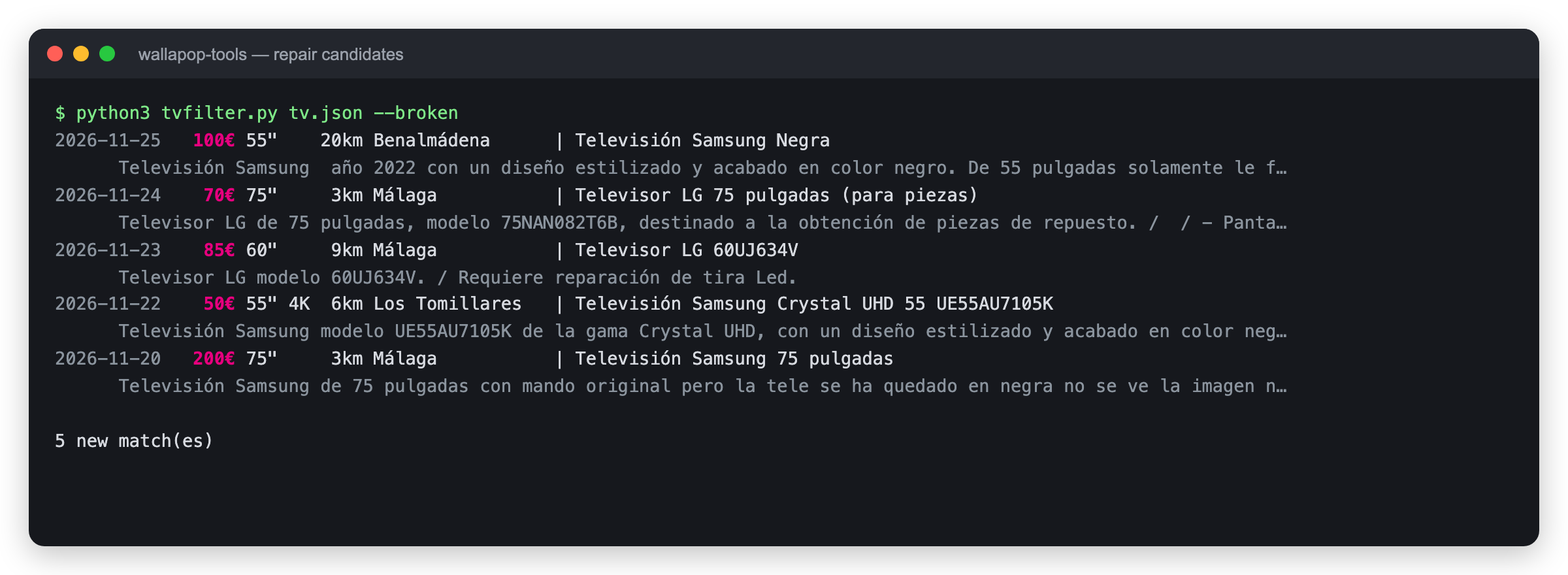
Two listings fitted exactly. A 2016 LG 55″ 4K at 50 €, with half the screen dark: the seller described the fault precisely, and it’s what this series is known for. And a 2021 Samsung 55″ 4K, also 50 €, “backlight fault”, from the same family as the working one I’d just lost at 140.
Then it went to AliExpress and found the parts. For the LG, the strip codes depend on which panel is inside, so: ask the seller for a photo of the sticker on the back, then order the matching pair, about 13 €. For the Samsung, an 8-strip kit at 14 €. It also told me which repair is harder (the Samsung: eight strips and a reflector sheet to re-seat) and one thing I’d never have known: that Samsung series burns out its backlight because the LEDs are driven hard, so after the repair, set the backlight to 70 or 80%.
Which led to the obvious next question. What if I buy both?
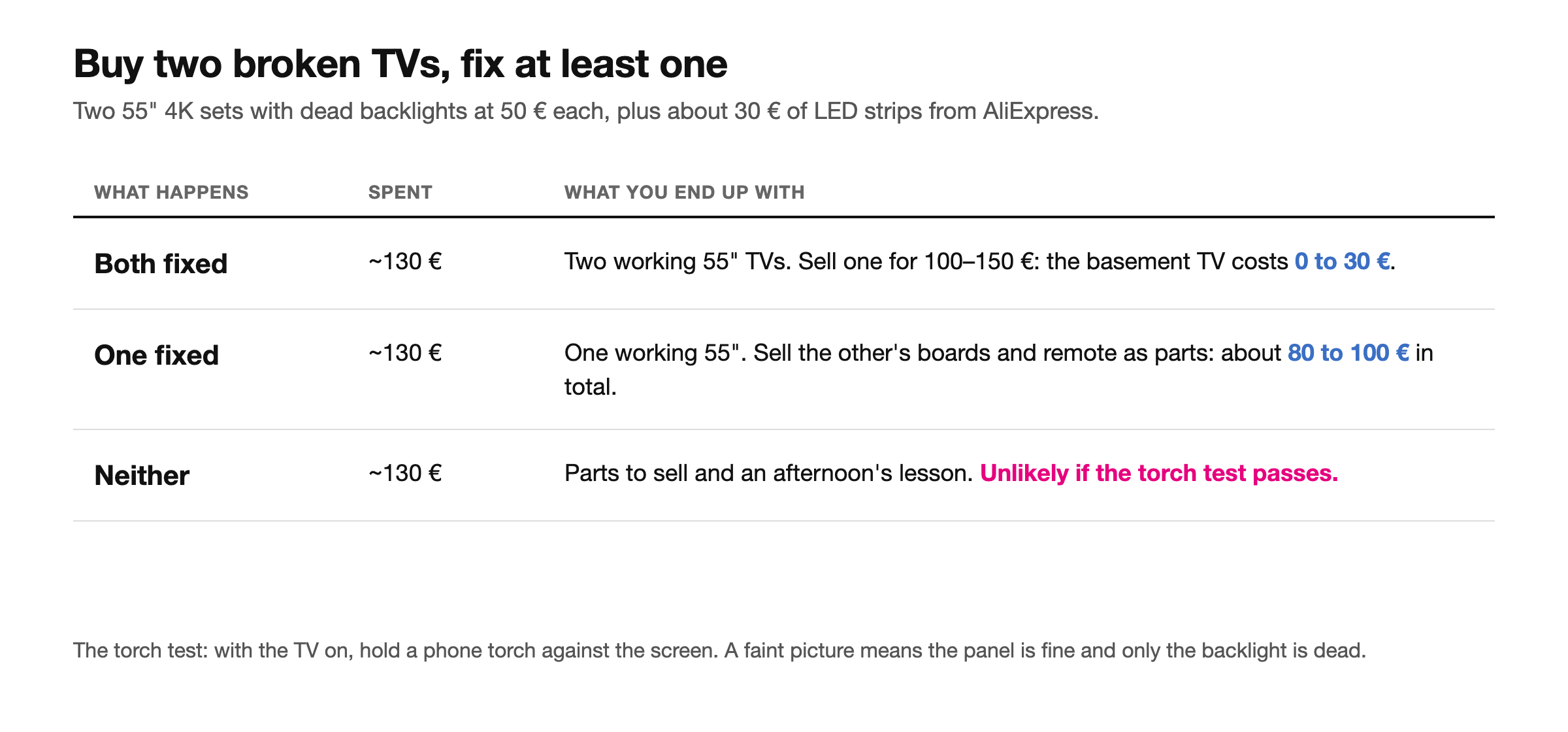
In the end I didn’t do it. Two afternoons with a 55-inch panel lying on a bed, a two-week wait for parts and a second TV to resell is time I don’t have right now, so the repair plan went back in the drawer. I don’t regret the hour spent on it, though. Working it through in theory changed how I read every listing: “backlight fault” used to mean rubbish, and now it means a 15 euro part and a decision.
The part that makes it repeatable: a script, not a conversation
That first evening had a problem. The search took about ten minutes, with the agent clicking through pages in a browser and reading everything, and good listings on Wallapop last hours. I didn’t want to pay ten minutes and a pile of tokens every time I felt like checking.
So the next morning I asked for tooling instead of answers: make this fast, and show me only what’s new. This is the step I’d recommend to anyone doing this kind of thing with an AI agent. The agent is expensive and slow at crawling, and very good at judging. So let a script do the crawling.
- A search script runs many keywords at once in a hidden browser, newest listings first, with images, fonts and ads blocked. 18 searches now take 15 seconds.
- A filter keeps flat 55″+ TVs, drops curved sets, parts and screen damage, marks 4K, and has a
--brokenswitch for repair candidates. - A memory. It remembers every listing it has shown me, so the next run prints only what appeared since.
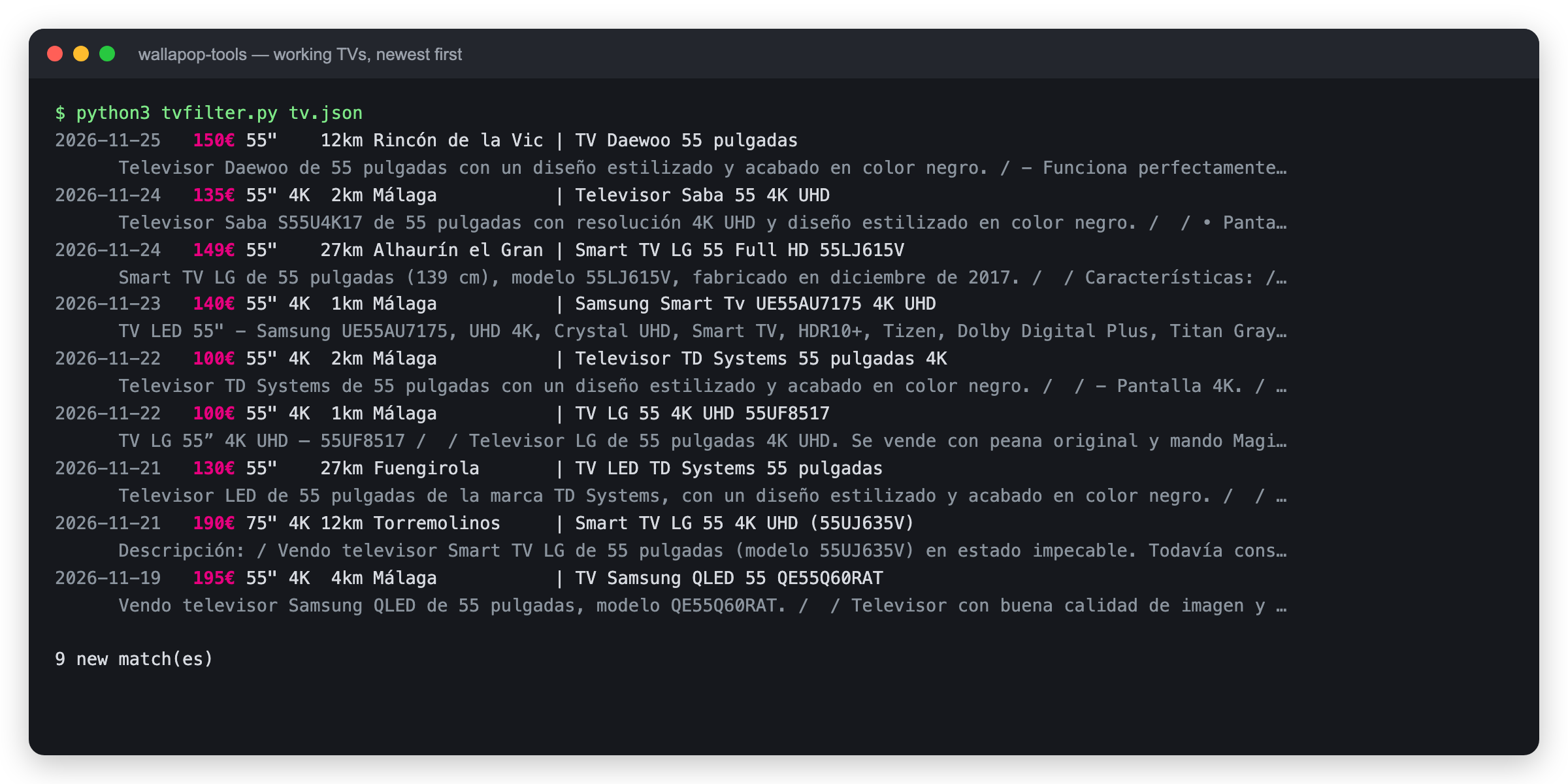
Now “run the TV search” costs seconds, and the agent only reads a dozen fresh lines instead of thousands of listings. That’s the whole trick: the crawl is done by plain code that costs nothing to re-run, and the intelligence is spent only on the handful of results that survive. The second run found a 2019 Samsung QLED at 195 € (“offer 160 to 170”) and a spotless 2017 LG that still had the protective film on its frame.
The filter also learns. One listing got through with a line across the screen, because the seller wrote “raya” and the filter didn’t know the word. It does now.
What I’d tell you if you tried this
- Ask for the research you’d do yourself. Model year, price when new, known faults of that series. The search is the easy part; the judging is where the hours go.
- Turn the search into a script on day two. Fast, newest first, and with a memory of what you’ve seen. Checking becomes a ten-second habit, and second-hand bargains reward speed, not depth.
- Learn the cheap faults, even if you never pick up a screwdriver. “Backlight” and “won’t turn on” are opportunities for someone with time. “Lines on the screen” is not, for anyone.
- Let it write the message. An offer with a reason and a pickup day gets answered. Mine for a 190 € LG: 150 in cash on Sunday, since similar sets go for 100 to 130.
- It gets things wrong, and the fix sticks. The scratched screen it missed because of one word became a rule in the filter, which is more than I can say for my own browsing.
I still don’t have the TV. The 140 € Samsung went to the Saturday buyer, and there’s an LG I may see on Sunday. But I know what every 55-inch TV within 50 km is worth, which ones are traps, and what a dead backlight costs to fix. A week ago I would have bought the first one that looked fine in the photos.
Next time: the same tooling pointed at smart-home gear, where I learned that shipping eats almost every bargain.
Prices and listings here are from the last week of November 2026 around Málaga. They’ll be gone by the time you read this, which is rather the point.
No comments yet